Average Reviews:

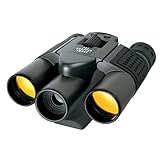
(More customer reviews)Here is a detailed technical review from an optics point of view. Maybe the details will be useful to someone.
Any binocular with 10 x 25mm options is going to have fairly poor performance in all lighting conditions, whether it has a digital camera or not. 10x25 means it has a 10x magnification factor which is a lot for a small set of binoculars.
25 means it has a 25mm main objective lens. The large 10xs zoom coupled with a small 25mm objective lens for gathering light (the large end of the binoculars) is going to be rather dim even in daylight.
Manufactures like quoting big numbers even if it's a good idea or not. So they went with 10x magnification vs 6 or 8x even though the lower magnifiction would work better with the small lens. 10x zoom provides a small 2.5mm image for the user on the other end.
The image size is calculated from the 25mm lens / 10x lens = 2.5mm image or 1/10th of an inch).
Trying to focus your eye on a 1/10th of an inch image is just too small so it appears small, dark, a bit blurry and is also pretty much impossible to hold still because the image fills only a small portion of your view while the strong 10x zoom magnifies hand shake quite a bit. Don't even think about using these while walking or riding in a car.
I'm not picking on these binocs in particular. These same limitations would affect all binoculars with the same 10 x25mm spec. It's just a poor design choice.
An 8x zoom (8x25) would be a big improvement in usability while 6x25 would be even better if using the same 25mm lens. If I could choose I'd get a 6x30 or an 8x30. A larger 30mm lens has a lot better light gathering ability while still being fairly compact and a 6x zoom can be hand-held quite easily for a steady and bright view.
Brightness goes up proportionally with lower zoom values.
But we're not likely to find any like that since manufactures build these to sell and they figure bigger zoom numbers are more impressive. They also use small objective lens (like 25mm) to save on cost even though it results in small binoculars with small, dark images.
Ideally the final image size would match the iris opening of a persons' eye, which is about 5-6mm. 5mm fills your entire view and looks very steady since the edge of the image is out of sight now.
So you could have a 10x50, 8x40mm, 7x35 or 6x30mm binoculars and they all have a full 5mm image and should work great.
That's why binoculars used to those exact ratio's for many years, because it works. While 10x25, and 12x25 do not work well. its just physics.
The Sharper Image set I tried out also had the optics misaligned internally so that the 2 images could not be joined together to form one clear image. This is unusual even in cheap binoculars. It was also difficult to get both sides in focus at the same time which was a separate problem.
Besides the unfortunate choice in optics the CCD detector (the digital camera sensor) is too small. It's only 640x480 dots which is .3 Meg. That's point 3 meg. Not 3Meg, or 10Meg. That is 1/30th the resolution of an average 10 Meg camera. This has little purpose since it produces images with insufficient resolution to print and barely enough to view. In comparison a quality digital camera produces images of 2000 x 3000 dots or more and that is plenty to work with. That's 3000 dots wide x 2000 tall from a fairly average camera.
This unit is more like one of those $10 toy camera's that come in a plastic bubble pack. Really.
So if you really want to use it and have it work, look for a built-in camera sensor with a least 2-3 Mega pixels to produce usable images.
I returned mine since there is nothing I can do with it.
Click Here to see more reviews about: The Sharper Image 10x25 Binoculars
 Get 38% OFF
Click here for more information about The Sharper Image 10x25 Binoculars

0 comments:
Post a Comment